Thursday, 10 October 2013

Glider - Postmortem

Glider - Postmortem
On Friday 13th September 2013 at 7:17pm I hit the ‘GO’ button at www.indiespeedrun.com and our theme of ‘First Planes’ and element of ‘ToupĂ©e’ was randomly generated for us to build a game in 48 hours.

Arguably this was one of the most challenging game jam themes I had been tasked. We struggled for a good few hours in trying to come up with an interesting or unique take on the theme.

 
The Game 
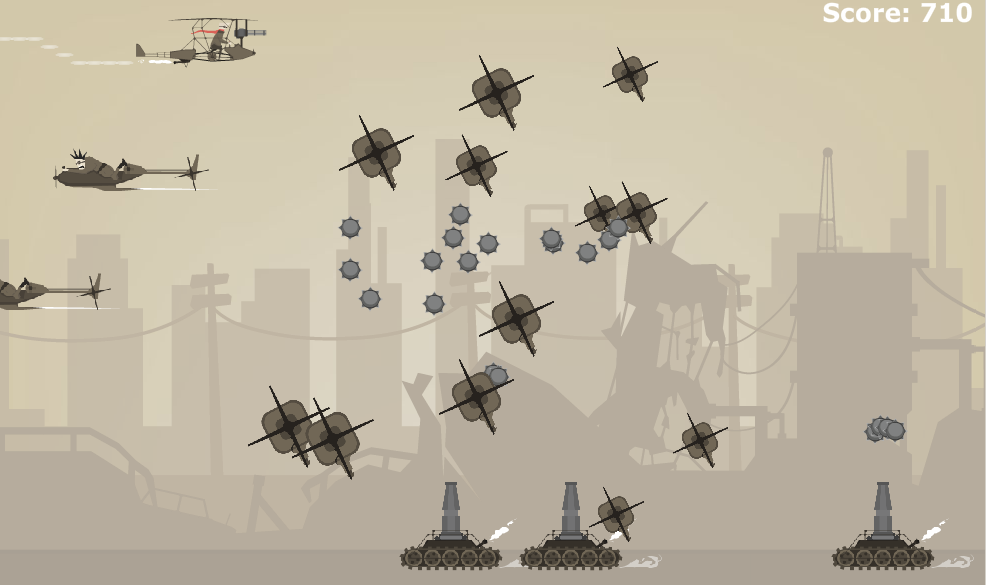
The game is a fairly straight forward avoider/shooter game with some minor interesting dynamics in place. I liked the idea of having a shooter game where all the characters in the game were piloting vehicles that appeared to be powered by kinetic energy. The art direction is loosely inspired by the imagery of Mr Da Vanci’s inventions.

What’s good about the game?
Ramping Difficulty:  The game has a stable difficulty curve that ramps up over time. It does well at introducing new enemy types by giving players a chance to see how they function as a singular unit. It’s important to teach players how a unit functions alone before overwhelming them with that enemy type and with other enemy combinations.

Customizability: This is both good and bad. It is good that the game features a customizable character. However, it’s bad in that it makes a very little impact in the game. The playable character is fairly small in scale so it is difficult to visualize. This was actually the first time I have worked on something with character customizability. From a design perspective this was maybe a little pointless and looking back I probably should have been focusing on designing units to make for an enhanced player experience with gameplay variety as opposed to a customizable player experience with limited gameplay.

Feedback (Kongregate): Some of the feedback we had for Glider was surprisingly positive. A large number of the suggestions made so far are for power-ups, mute button, less repetitive gameplay/more enemy variants. Glider definitely seems to appeal to a certain type of gamer, with a little research into the specifics of what these types of players look for and don’t look for in the games they play could really help Glider develop into a more gratifying flash game.

What’s bad about the game?
Replay Value: When players die in Glider, they are sent back to a loose screen where they then have the option to replay from the start or select outfit. Other than the fact they can change the outfit of the character there isn’t much in Glider does well to motivated players to play again from the start. This could be overcome simply by keeping players in the game, giving them a less harsh penalty for dying with the loss of potential high score record as the only downside to dying perhaps. Alongside this it would be important to give quick respawn times to make for instant and even faster paced action crossed with constant flow of action gameplay being thrown at the player.

No Substance: What I mean by this is that it’s nothing special in terms of artistic value or originality. Of course, there’s nothing wrong with that. It would have been nice to experiment a little more with something that had a little bit of substance or potential for artistic merit. Of course iterations could always be made to give a game like this artistic substance. I like the idea of making a shooter where player play as the bullet. It’s important to consider what any type of game doesn’t do and experiment with those ideas for substance.

Gameplay Variation: As there are only 3 different variants of enemies to shoot there is limited dynamic variety in the core gameplay. As a result it players tend to gets bored fairly quickly once they have been exposed to all enemy types. This can easily be overcome by simply adding more enemy types and then building levels with variations of each combined into randomly generated positions of set waves.


What I learnt

Pacing: One thing that is fairly interesting and new to play around with for this jam was the pacing of a game. Generally speaking the games I have made in the past have been quite slow paced or ‘clunky’, Glider was purely an attempt to make a fast paced game.
I learnt that when designing levels it is sometimes nice to give players a moment to take a break – particularly in games with extended periods of faced paced gameplay.

Art Style: Because we had to pay a $25 entry fee for this jam, and as well as some of my favourite games designers judging (Jason Rohrer) there was a lot of pressure to make something of a high standard, which arguably is in some parts. With this in mind, we very much played it ‘safe’, particularly on my part in terms of art direction. The art is very similar to a game I had previously made I felt in the shadow of the last game I worked on and was a little bit hesitant to leave my comfort zone and try something new for this jam specifically with all the pressure. Looking back I could have been valuable from a learning perspective to take that risk. 


Monday, 7 October 2013

Indie Speed Run Game! - Glider

A game I made in 48 hours under the themes of 'First Flight' and 'Toupee' is now live on the Indie Speed Run site. You can play it and if you're feeling kind rate it directly from this link. Feedback is of course always welcome and I hope you enjoy.  I will post up a postmortem analysis very soon!

Friday, 4 October 2013

The Importance of Game Jams

On Wednesday morning, I presented a 20 minute session to a room of fellow students on the importance of Game Jam events and why more people should in fact be doing them.
 

For all those who missed my presentation session I will be briefly going over what I talked about in this post:
Why are they important?

Learning: You'll be surprised at how much you can learn in a short time frame, in fact I have probably learnt more about making games in 48 hours than I have when working on a game for a couple of months. This might have something to do with the short time frame or condensed hours all merged into one blurry sleepy experience. I see every game as a stepping stone to the next game. You'll learn something new after each and every game jam and with that is one step close to potentially making some thing that people will enjoy.

Passion: Telling employers at an interview that you've participated in a game jam is always a bonus. It tells them that you're clearly passionate, that you're willing to make games in your spare time and that you've done more than what was asked of you for your university modules. If you like the idea of working for a company or games studio then there's nothing that shows your passion for making games better than game jams. It gets your face out in the world and gives you something to talk about. The more events you attend, developing games will become natural to you. For me, my passion for making games grew the more game jams I entered. It's given me experience and knowledge that justifies my passion when talking to other developers.

Networking: Jams for me are the best place to build up my networks, not only with people who work in industry but with other students to share/compare projects or even to find someone to work with. It is the ultimate place to get your work seen by industry folk, often companies sponsor game jams and give prizes out to promote their company, they often come to these events looking for talent and people to hire. If you're good enough and you're passionate you might even end up with an interview or even work. If not, they will be more than happy to look at your portfolio or CV and give advice from experience. Bottom line is, if you're looking for work in the games industry game jams are possibly the best way of finding it.

Industry encourages it: If you want to prepare yourself for the games industry with pressure filled deadlines and crunch times, then games jams are good practice for giving a taste for how the industry runs. Also certain companies even hold in house game jam events to their staff when pitching or coming up with a new game idea to develop.

Communication: It's so important to talk about you games, and to learn how to communicate your ideas. Game jams are a good work out for your game design brain. Making games uses your whole brain, chances are you're lacking in some area, so working and communicating ideas with others is important.

Advice & Tips

Aim Low: All of these tips are mainly aimed at first timers or those who are new to game development, so they go with out saying. There's nothing wrong with aiming low, in fact I think there's no such thing as aiming too low because you can always add little details and tweak gameplay afterwards. The best games I have made at jams have usually been the most simplistic idea, it gives you room to really polish what you have. It's also important to remember that you're not a big company with thousands of people and you may only have 48 hours! So it is crucial that you work with your limitations. Limitations are great, they can sometimes make for more unique or interesting ideas or mechanics and there's nothing wrong with that, less is more!

Priorities: This is SO important! Try to get something playable or the core mechanic of your game idea coded in FIRST. The sooner you have something playable, the sooner you can begin getting people to play test your game and then the sooner you do that you can iterate and make tweaks. Don't worry about the credits, the main menu, or pre-loader, these aren't relevant to the game experience, you can always add these things when the jam is over.

I've known people to build 'game templates' prior to jams which include a preloader, main menu including buttons with sound options in and a game screen all blank and with placeholder art. There's nothing wrong with doing this if you already know how to add these things into a game why waste time adding them in at the last minute for a game jam. Prioritizing what is the most important thing to work on at the time is cruicial for a successful jam game. it is always a difficult one and I still get it wrong from time to time. I've wasted time doing custom character outfit menus and selection screens at jams where I should have been designing unique mechanics for more variations of enemy unit types to mix up gameplay and add variety to the overall player experience, it always shows in the game when priorities have been ordered wrongly.

Will players 'get it'? Once you have your game functioning a little, with perhaps some basic controls or mechanisms. It is best from relatively early on to close your game, re open(compile), step back and pretend you're a completely new player who has never seen this game before. Consider what they would do. Where are their eyes drawn to on the screen? Think about the controls of your game, what inputs need to be made? Could you change your controls to make it easier? Are the controls too complicated or difficult for players?

Think about how you can teach players how to play your game. Interactive tutorials are more enjoyable and sophisticated way to teach players but longer to implement as opposed to help pages. If you use any text, think about where it's placed, consider typography. Remember, less is more. What would work well in your game?  Make the first level near impossible to die, teach players by slowly introducing mechanics, ramp up the difficulty. Try to get a good balance between easy and difficult, you as a designer will be naturally good at your game because you made it, make sure you account for this when designing the first level.

Postmortem your work: After every game jam you do, try to postmortem your work. When you're physically writing something down it helps you to further understand the process. Talk about what's good and bad about your game, consider what players like and didn't like about your game. Think about how you could improve it or what you'd do differently next time from a design perspective only. Try to avoid talking saying things like 'I wish I didn't drink so much on the first night of the jam', think about the game and the direction you could take it.

Feedback: Feedback is a natural part of making games and it's crucial if you care about making something which can be enjoyed by a lot of people. Of course, not everyone is going to like what you do and sometimes people may actually be offended which isn't a bad thing. I think if you can trigger a passionate negative response from someone then you have the potential to trigger a passionate positive response from someone. It's always good to ask people questions when reading feedback. It's good to be humble about your work and really look at it for what it is, be open to suggestions there are many ways of approaching game design and the way that you may have approached it might not be the best. Ask people what they like/didn't like and why.

Competitions & Upcoming Events

- Global Games Jam www.globalgamejam.org
- Ludum Dare www.ludumdare.com
- Indie Speed Run www.indiespeedrun.com
- Game Hack www.gamehack.co.uk
- The Walking Dead Games Jam www.thewalkingdead.com/Gamejam
- TIGjam www.tigjam.com

A lot of people ask me how do you find these programmers to work with (I'm an Artist/Designer) for all these different game jams. The answer is, just go to these events and you will meet programmers or artists or designers who are looking for someone to team up with.
You can download the PowerPoint presentation of the session here: link

Thanks for reading, hopefully someone will get something useful out of this post.

Wednesday, 18 September 2013

Ludum Dare #27 Results & Response

As of yesterday the results for Ludum Dare #27 were released after a month long public judging session. Here's how my entry "The Saddest Landscape" placed overall out of all the entries submitted:

Ratings:

Coolness100%
#5Mood4.22
#16Audio3.95
#23Graphics4.31
#392Overall3.22
#756Innovation2.71
#808Humor1.82
#1009Theme2.56
#1079Fun2.12

I was able to place in the top 25 for 3 out of possible 7 categories in a total of 2,213 games submitted:
 

I am very happy with this result as I feel I have gone above and beyond my previous Ludum Dare #26 result significantly which tells me that I have improved as a designer. I hope to further exceed or par with these results in the next Ludum Dare event in December. I will continue to enter these competitions in the ability to further my game making skills and to hopefully one day be placed in the top 100 games submitted as a long term goal.

I have had some minor online response to the game without sending it out or asking people to play which has been quite reassuring. Someone did a really nice blog post about the game, unfortunately it is in German so using an online translator is required.

Someone also featured the game in a Youtube compilation video of his top 21 Ludum Dare games.

Ludum Dare Result Comparisons:

Friday, 13 September 2013

Indie Speed Run 2013


All set up and ready to go
As of later today myself and Joe Kinglake will be competing in the Indie Speed Run 2013 48 hour game making competition.

Supplies for the weekend are in, laptop is all setup, drawing pads and paper are out, the entry fee of $25 has been processed and I have my credit ready to hit the 'Go!' button to randomly generate a theme. This should be an awesome weekend ahead!

Judging 
The main reason I was initially drawn to this jam was because of the awesome lineup of judges that get to play the game that you make. One of my favourite designers judging is Jason Rohrer of the game PASSAGE. As well as many other known industry professionals. Also, if you haven't played PASSAGE, I recommend it highly, his approach to design I find highly influential. 


I'll postmortem analysis the game soon, however it's against the rules to publish the game online until judging starts in October. I'll check to see if writing about it in full detail is allowed, if so expect a post early next week if not sometime early October for a postmortem.

Thursday, 12 September 2013

Super Meat Boy Editor - Miscellanous Experiementation

As of recently I've been messing around with Super Meat Boy Editor just to try something new and to keep my design skills up to scratch.


You can watch a video of what I made here: link
I’m quickly going to discuss the functionality of the editor and why I think it is a good design exercise for any beginner designer to take advantage of.


What's good about it 
Testing capabilities
The editor is really nice at prototyping any ideas for a cool level that you may have. Pressing ‘F1’ jumps back and forth into play mode and dev mode. You can also move the spawn point of Meat Boy by pressing ‘B’ which proves extremely handy in skipping areas to test a specific section of the level.
Limitations
As a designer the limitations that the editor features prove an excellent design exercise in further developing one’s ability to make a fun and solid playable level.

What's bad about it
Saving
Saving levels seems a bit shady, I’ve only been using it for a couple of days now and I haven’t been able to load any of my existing levels which I’ve saved before. They probably still exist somewhere on my pc in the editor file location, but as of yet I haven’t been able to locate these files. I’ll spend some time looking into this and hopefully resolve this issue.
Uploading
Unfortunately you can upload your levels to the Super Meat Boy world due to it being hacked shortly after its release.
All the bad points aside, the editor is only a beta. However I do think it allows for some really awesome design practises for those who are just starting out in level design who haven’t yet written their own editors. In addition to presenting a nice framework to build upon and improve for those who are writing their own level editors.

Wednesday, 4 September 2013

The Saddest Landscape - Postmortem


So under the theme "10 Seconds" for Ludum Dare #27 you can view and play my entry here: "The Saddest Landscape".


What went well 
Established an interesting link to the theme fairly quickly: “10 Seconds” made me think of old school films in which have a countdown such as: link. This then led me to think about old film projectors more specifically a film reel or film negative strip. I thought it would be interesting to create a world that lies within a filmstrip, and that players themselves are in turn telling themselves a story as they play it, this was how I interpreted the theme. I was surprised to find a number of people who thought I hadn’t considered the theme and were unable to see the connection.  There is no gameplay mechanic that directly links to the theme; my interpretation was purely visual and aesthetically which I felt could have been the reason for this misunderstanding.
Making artwork and animating: Creating art and animating are my stronger side so naturally this went relatively smoothly. I feel I do well in establishing a certain feeling or mood in the game and are happy with the results. I didn’t want to do a purely black and white game as my old LD26 game was all black and white; I wanted to have at least some hint of colour. So I went for an old sepia brownish tone which was intended to give an old fashioned kind of feel, that I hope it does.
Managed to submit something: Having almost scrapped the idea midday Saturday to do something that was easier for me to program (I was thinking of a point and click adventure perhaps) I was happy that I stuck at it and managed to submit something that ran relatively smoothly. 


What went wrong
Learning AS3/Coding: I’m not much of a programmer but I love coming up with interesting design ideas for games which is why I participate (and to learn). But I got very frustrated throughout programming the game which is why this entry isn’t as substantial as it could have been.
The game mechanic I wanted to implement would have been that the characters could let go of each others hands and that when separated one can make it over further to reach gaps and aid the other character across, so basically hints of puzzle elements to the game.
Bugs (oops): I submitted the game with one silly bug I knew about but completely forgot to fix If players hold the ‘up arrow’ key the characters just fly up endlessly. There are also some minor collision issues which are beyond my knowledge of programming to fix so I just had to work around these issues throughout development.

Not Much of a Game/No Gameplay: I think I ever so slightly bit off more than I could chew as I know very little AS3. This meant that I was able to get a concept out but unable to implement a game mechanic and to design some intrigue levels with a nice curve around this mechanic. However I learnt a ton of new things because of this. What I submitted isn’t much of a game (yet) more of an interactive storytelling conceptual piece and proof of concept.

What is next
I’m fairly happy with the concept and I feel it has a lot of room for potential. I plan to continue working on this due to the nice feedback I have received from fellow devs. I have found myself a programmer and we’re currently working evenings and weekends to maybe make this little prototype into something hopefully substantial. All the artwork/characterization will be further iterated and touched up for a more unique/established art style based on some very valuable feedback I have received. A solid game mechanic will be put in place which in turn will give some puzzle elements to the game, as well as adding some variety to the twitch skill mechanics currently in place for platforming.

Thank you to everyone who played and for your kind words.