This weekend from Saturday 16th - Sunday 17th of November I will be participated in Game Hack 2013 located in Pinewood Studios. This is a 24 hour jam which is half the time of a typical Ludum Dare, consideration to the scope of the game we plan to make will need considerate planning. A postmortem of what I create at this jam will be posted sometime after the jam.
A couple of weeks back I participated in The Walking Dead 'All Out War' Game Jam along with Joseph Kinglake, our entry has been featured on the Walking Dead site a number of times as an entry that caught the judges attention: We placed in the top 19th out of a total of 70 games submitted worldwide and were featured on the site again as of October 27th. As of November 11th the entries were cut to a final 10 of which we were chosen. This meant winning a copy of Unity Pro license, a Steam Greenlight key, the game being exclusively featured on thewalkingdead.com and an article soon to be featured on Eurogamer.net, as well as a ton of signed walking dead merch and goodies... the post can be found here
We got some feedback on the game from the judges: "We weren’t expecting an emotionally-focused game about loss of life
during a war to come out of this (even though we suggested something
along those lines when illustrating what the teams could submit), but we
were glad to get one and we found this entrant to be superbly executed.
The music, art style and use of color worked well together in
expressing a depressing concept, in a game-like environment. And this
one was put together in 48 hours!"
Myself
and Joseph Kinglake participated in what was intended to be a 2 week long game
jam in about a weekend and 2 evenings. In total, we probably put no more than
48 hours of solid work into this little prototype. The event was an online jam
hosted by Skybound Studios, creators of The
Walking Dead. The given theme was 'All Out War', more information and detailed rules on the jam can be found through this link.
The 10 best entries will win prizes as follows:
Super-special Walking Dead prizes, including signed special books, merchandise and t-shirts.
A full Unity Pro license for each of the 10 winners.
A Steam Greenlight key so if you choose to build your winning game
further, you can ask the Steam Greenlight community to help bring you to
the Steam platform!
And for our Number 1 pick, all the stuff above, plus…
The endorsement of Mr Robert Kirkman, should he pick you as our grand prize winner game from the 10 winners.
The Game
Remember
the Fallen was our best attempt at a War Memorial tribute game. Inspired by the aftermath imagery taken of the nuclear bomb explosions on Japan in
1945. The game was made to honor the people who suffered during the atomic bomb explosions and the lives affected and ruined for generations as a result thereafter.
Nagasaki, 1945 [Online Image]
Atomic Bomb Survivor [Online Image]
At its core, the prototype is a simple hidden object game where players have to discover flowers in the environment to then place onto the graves of fallen soldiers. Players can simulate the process of paying tribute to the dead. We wanted to give players the freedom to explore, and those who do are mildly rewarded with the ability to interaction with certain unique assets.
The teaser trailer for Remember The Fallen can be found here: teaser trailer
The gameplay for Remember The Fallen can be found here: gameplay trailer
What Went Well
Taking Risks:It isn't everyday that people design a game inspired by the atomic attacks on japan. We very much pushed ourselves creatively to take a big risk in terms of subject matter and visual aesthetics. From a indie design manifesto I take guidance from it states that, "Try to innovate the hell out of anything you make. From how your game
plays to how it looks, be unique and you'll stand out. Push your
personal limits, try new genres, mechanics and aesthetics.
Experimentation and risk are the keys to growing as an artist." (McMillen, 2009). This was the first official game jam that had me working on a 3d game, initially I wanted to use 2d pre-rendered assets into Unity - however I am glad I took the risk to move ever so slightly out of my comfort zone. I learnt a ton about Unity game development processes, I am more open to the idea of working within Unity whereas before I was a little close minded as well as skeptical towards the tool - I do still favor Flash over Unity but am more open to work in it depending on the game idea for suitability.
Feedback & Response: People have seemed to peak more of an interest to this piece compared to my other game projects which has been interesting to say the least. I've had friends say that I'm actually making 'proper' games now - purely based on the fact that it is a 3d game, of course, this is ludicrous. Nonetheless I do consider it a strong peice conceptually but not the strongest in terms of gameplay - note that strong gameplay wasn't our core intention when designing the game. We approached it with the intention to make something interesting on the given theme. The feedback has been fairly positive but it is clear that some players do find it boring, the process of finding and placing flowers isn't that motivating to the player. The most motivating comment we had so far was from one of the employes from The Walking Dead who said, "You're one of our strongest entries by the way, so well done.
You planned and executed beautifully. If you don't already make games for a living, you definitely should be".
Not Over-scoping: In game development, the term over-scoping means you've 'scoped' bigger than the game needs to be. Sometimes our ideas and aspirations are greater than our abilities.
Feature Creep is when you are mid development and you start having
additional ideas which sidetrack you off the task in hand whilst elongating the development time. We scoped this game realistically in relation to our time constraint, technical abilities and skill limitation in the Unity engine. Naturally tasks were prioritised - whilst Joe began focused on implementing the core mechanics and establishing game controls to feel nice, I was working on building an plethora of assets to be used for set dressing. We discussed design choices in relation to the throughout development. When you're working on a game that has a 'finished when it's finished mentality' attitude it can linger for months and ultimately you may lose your enthusiasm and shelve the entire game. "Feature creep is inevitable and so you should expect it, and even assign
time to it. This will make you more adaptable and flexible when
developing games. The trick is to manage it and not let it manage you." Ian Garstang (2013)
Unique Take on The Theme: We pushed the minimalist aesthetics and some of the unique qualities of the game in order to stand out from the other potential entries in the competition. A lot of deep deconstruction and thoughtful consideration went into how we planned to interpret the theme prior to the event. We'd previously done a shooter game for the Indie Speed Run competition so we were inclined to push ourselves towards something more than 'just a shooter'. Not rushing into an idea can sometimes be beneficial - particularly when dwelling deep on a subject matter.
Limitations: Working with limitations is great, it makes for interesting and unique ideas. As a designer you want to embrace and explore any limitation that you may have. You should never put off doing a game because say 'your waiting for a new piece of software to come out', you should just do it - work with what you have and you'll find that certain qualities will shine through. Simply doing a game jam is a limitation in itself, time is against you. It will limit the scope of your idea and train you to think in particular way when designing.
The main limitation we had for Remember The Fallen was time, we started the jam about a week into the actual event so the scope for the game had to be fairly minimalist. Also we could only work on evenings and weekends due to jobs and university. Embracing this limitation helped achieve a very specific type of aesthetic in the prototype. We both knew from the beginning that we wouldn't have any time to unwrap and texture any asset, so we didn't. We worked purely with blocked out grey toned low poly assets using scripted filters in unity and minor particle effects to build a traditional grainy film aesthetic. I wanted players to feel like the world is coated in ash - a minimalist blocked out grey-scaled world helps to achieve this, whilst giving connotations of isolation, abandonment and loss to the player.
The lecture below by Petri Purho discusses why limitations are good for creating games:
What Went Bad
Fun: As it stands, it's a nice 'proof of concept' piece, it has a lot of potential to be something cool. To put it bluntly it isn't very fun and arguably boring to certain players. It is the kind of thing that players need to sit down alone with headphones to fully enjoy searching for what it may have to offer. I like the idea of having mini games/micro games incorporated somewhere in the world, perhaps some combination or number finding puzzle elements which players have the freedom to solve - this might help to enhance its substance and possible open up possibilities for emergent gameplay. Rewarding players for 'thinking' or making them feel smart is always a good thing.
Submitted Early:Technically this isn't particularly a bad thing, however due to confusion over the time zone for game submission we e-mailed over the game with about 24hours to spare. They did seem impressed quite impressed by the entry and the fact we submitted early which was cool. There probably wasn't too much else we could've added to enhance the experience in the time frame that was left anyway - mainly just little tweaks here and there, all the features and mechanics that we wanted to get in were in. Anything else would have just been further set dressing.
Initial Self-Doubt: It's always intimidating trying something new due to fear of failure. I'm glad I entered the event as it was a huge learning curve for me. I'm more than happy with what we made, it illustrates perfectly to the judges what kind of designer I am and the types of games I'm interested to make. Like all the games I make, I do see this somewhat of a stepping stone to the next game.
Internet Speeds: As Joe was working from Amsterdam and myself from UK both of our Internet connections for the duration of the jam were critically slow (mine is awfully slow anyway) - sending over/sharing work was a long and nail biting process. The main sound file for the game took around 2 and a half hours to send so there was a lot of pressure to ensure that the file was right for the game build prior to sending it! It was tricky to iterate the game with this constraint but we just about managed - there was a constant flow of new or updated files being thrown into the Skype chat.
How I'd improve it further
I've been considering how I'd improve the game and that's the kind of question that as a designer you always have to ask yourself because naturally there's always something that can be improved. The direction I'd like to take RTF is in the form of a fully fleshed out War Memorial Tribute Game. I would like to design historically accurate events in war history with appropriate research into the time, location and culture of the event. For example, a level of London during WWII which features players finding poppies to honor the fallen. Similarly an accurate stilled account of Hiroshima and Nagasaki levels that feature white flowers which are culturally accurate to Japans process of honoring their dead. Likewise with such locations and events from, Berlin during WWII, United States during September 11th 2001, the Jewish faith and Auschwitz etc.
Another area I'd like to improve If
I were to develop RTF further, is to give players more
significant rewards for finding and placing flowers - possibly through a system that unlocks new components in the area where the flowers
were found, giving players a reason to backtrack to the already explored
area. The rewards could be in the form of unlocking particular personal insights into the peoples
lives of the graves just before the nuclear explosion. I like the idea of presenting players with the ability to interact with people, holding their hands, waving, etc.
There's a lot to be said on what could be done to further enhance the players emotional response from the game, I'm looking to produce a Design Document on this in the near future outside of my current University studies.We're
currently waiting on result for game jam finalists, The Walking Dead
site get exclusivity of the game on the site for 2 months. I will update
and post the link [here] when it is available.
Thanks to everyone who's peaked interest in the game and thanks to The Walking Dead for hosting the event, good luck to everyone who participated.
- note this post may change due to further proof reading and changes
Sources Referenced:
- Image 1:
Prof. Chris Bursk. (2012). Atomic Bomb Survivors Meet Harry Truman’s Grandson: Testimonies and Discussion on the Nuclear Age. Available: http://cfpabuxmont.org/wp-content/uploads/2012/09/Hiroshima_aftermath.jpg. Last accessed October, 2013.
- Image 2:
NA. (NA). A Photo-Essay on the Bombing of Hiroshima and Nagasaki. Available: http://www.english.illinois.edu/maps/poets/g_l/levine/bombing.htm. Last accessed October, 2013.
- Indie design article suggesting to 'Take big risks.' (section 4.)
Edmund McMillen. (2009). Opinion: Indie Game Design Do-s
and Don't-s: A Manifest . Available:
http://www.gamasutra.com/view/news/26577/Opinion_Indie_Game_Design_Dos_and_Donts_A_Manifesto.php.
Last accessed October, 2013.
- An article that discusses over-scoping in game design:
Ian Garstang. (2013). The Over-scoping Game Designer – The Attack of the Feature Creep.
Available:
http://www.debugdesign.com/2013/01/12/the-over-scoping-game-designer-the-attack-of-the-feature-creep/.
Last accessed October, 2013.
- A lecture on working with limitations when creating a game:
Petri Purho. (2011). Why Being Poor and Having No Budget is Good For Making Game. Available: http://www.youtube.com/watch?v=iwXFOgNVMww. Last accessed October, 2013.
I have been searching for available job vacancies that are looking specifically for Junior Designer positions. The job requirements are listed below, I highlighted the areas and skills in which undertaking my dissertation will cover for this potential position. A link to the studios jobs page can be found here
What you will be doing:
Implementation and iteration of the core game mechanics
Production of detailed design documentation
Working closely with the Product Lead to help with future feature and mechanic creation and implementation.
To be a great fit, you’ll need to bring the following things with you:
You will have at least a 2:1 degree in a technical subject. Ideally
you will be able to show examples of games or game content you have
made in your spare time.
You are a highly motivated and enthusiastic individual with a
passion for creating great games and a desire to make great gameplay for
a worldwide audience.
You are able to demonstrate an understanding of what makes fun and
compelling gameplay and have the ability to identify and determine the
difference between good and bad game design.
You need to be highly technical and able to analyse complex data. You’ll be excellent at Maths, logical and organised.
You have a good knowledge and appreciation of the mobile game space
and are able to offer a considered opinion as to why some games maybe
more successful than others.
You relish the opportunity to take responsibility for key areas of
the game design and mechanics and become an important member of a
productive and focused team.
You are able to work well as part of a team in addition to being able to work independently with minimal supervision.
Happy take other’s opinions on board and evolve your designs.
You have ability to learn and master new tools and processes quickly.
Good written and verbal English skills are essential. You will be asked to provide examples.
Want to really stand out? Know about these!
Have worked on a shipped title.
Proven industry experience
Knowledgeable about a wide variety of genres.
Worked with User Experience and UI creation tools.
Since discussing a game idea with my lectures I was recommended to look into the work of Scott Rogers and how he approaches puzzle design. I have been reading the book "Level Up - The Guide to Great Video Game Design by Scott Rogers" in order to further understand a more solid and sophisticated approach to puzzle design. In a lot of my work, not all, but some, it's clear that the mechanics are either non-existent or lousy so I hope to be able to learn something from this study. I have churned out all the useful information from this chapter that I feel I could benefit from further understanding for when approaching both rapid prototyping and designing levels. Rogers tells us that "There's nothing worse than an empty level you just walk through". Players need conflict, as a designer you can throw things in front of the player both good and bad to make the player cry with pleasure and weep in sadness, mechanics are how we can do this. There are four kinds of these things to work with:
Mechanics
Specifically video game
mechanics are object that create gameplay when players interact with
them. They can be jumped on, activated with a button press, or pushed
around. Some examples of mechanics include: opening/closing doors, pushable blocks, switches and levers, slippery floors, conveyor belts, moving platforms.
Hazards
They look like mechanics, they often act like mechanics, but their purpose is to kill the player. Hazards can also be resembled as enemies, but the key difference is intelligence and/or mobility. All hazards have predictable patterns and limited movement. Some examples of hazards include: spiky pits, smashing blocks, blasting flames, exploding barrels, laser guided missile launching turrets.
Rogers tells us that when designing hazards it's important to make them clearly dangerous for the player. Get information from things of danger in the real world for inspiration try using shape, colour, sound effects and particle systems - anything to make it inherently clear to players that they WILL get hurt when colliding with the this hazard. Try to make a connection with your games themes and the types of hazards that would fit. "Instant death hazards just suck" They are cheap and mean-spirited. If the player is going to die because of a hazard, let them die because of the they didn't pay attention or get the timing right. Make them realize it was their fault they died, not because the designer decided they needed to die. Death is never a good way to educate the player. It just causes frustration and sadness. The secret to balancing great video game design is knowing this: Difficulty = Promotes pain and loss Challenge = Promotes skill and improvement
A difficult game does whatever it can to punish the player. A challenging game confronts the player with obstacles that can be overcome with skill and knowledge. Rogers refers to the balance between challenge and difficulty as the "fun curve." he states the actual psychological theory about the fun curve called "flow". The key to keep players from going over the fun curve is to create ramping gameplay. A designer must build one gameplay system upon the last, teaching the player a new move and how to master it against mechanics and enemies. The gameplay elements are combined and gently intensify as the game progresses.
Props
Props are mechanics that don't move. Props can be placed into the level to make it feel more like a real place. They can sometimes act as obstacles or barricades that players are able to use to avoid, jump over or take cover behind. Allow players to be able to interact with your props in your world, let players knock over light items, shove around heavy ones, closely example interesting pieces of statues, bookshelves or paintings. You can use breakable props to access new areas or yield treasure. There's nothing more satisfying than breaking things to get a load of treasure, but try not to overdo it as it can turn your carefully designed gameplay into a mindless smash fest. Crates are breakable items that yield goodies and double as platforms, but they're also overused clichés that have become a joke within the gaming industry; visually boring and, frankly, a lazy fallback for designers and artists who don't want to burn the brainpower to think up more interesting breakable objects. Here's a list of breakable objects you can use to populate your game with other than a crate: Barrel, treasure chest, vase, urn, trash can, mailbox, newspaper stand, baby carriage, metal drum, cargo container, cardboard box, cage, lantern, lamp post, filing cabinet, fish tank, toy box, keg, hay bale, pile of skulls, dog house, bird house, tiki idol, statue, fortune-telling machine, church donation box, suggestion box, ATM, hollow tree stump, attaché case, safe, suitcase, TV monitor, fuel tank, refrigerator, oven, breadbox.
There is one more type of mechanic which is the rarest one of all. It's that mechanic that's "just for fun." This can be the player piano that plinks out a tune as you approach it or the toilet that flushes if you interact with it. Don't be afraid to include these just-for-fun props in your game.
Puzzles
Timing puzzles are mechanics that move. They are perfect for creating tense moments where the player has to wait for the right movement to dash through whirling blades or smashing pylons. They cause players to experience anticipation as they wait for the right moment to jump to a moving platform. A timing puzzle should have the following: 1. The hazard must have a discernible movement pattern. Back and forth, up and down, zigzag, circular, or figure of eight. It is important that players are able to track the movement of this hazard. 2.The hazard must have predictable timing. Random timing is unfair in order for the player to understand the pattern successfully. 3. The window of opportunity must be tight, but not impossible. Allow leeway for the player at the stat and close of the window's opening. 4. Use "tells" in the world to give the player clues to where it is sage to stand and where they will be hurt or killed. Players will notice these things and will learn to use them as markers for success.
Doors
Doors hold their own set of issues when designing a level. Think about how the player is meant to open a door. Be mindful of which way your door opens. Does it open in? Does it rise up? Does it lower down? Does it swing out? all of these opening actions can lead to different gameplay scenarios. Even a simple door in a survival horror game can be closed in the face of an enemy to buy the player the time to reload or escape.
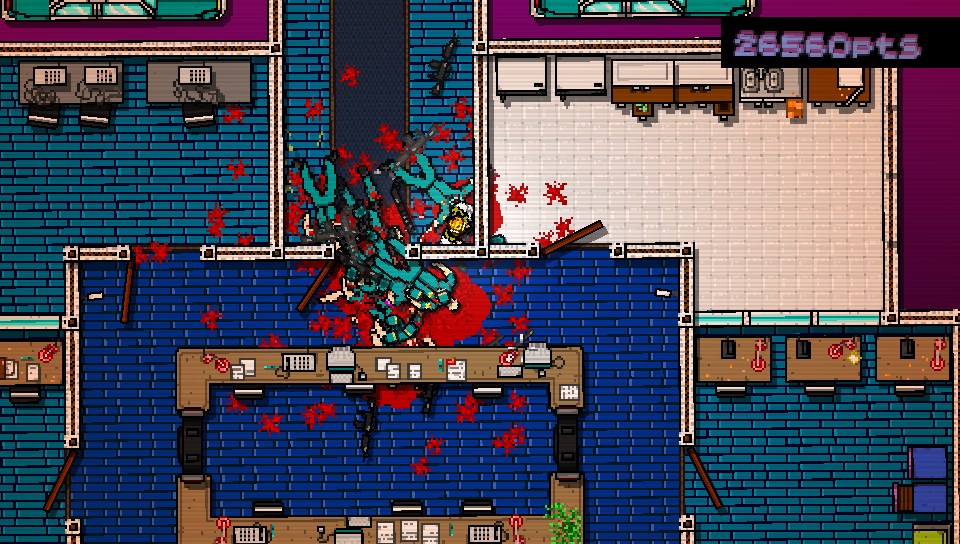
The game 'Hotline Miami' features the use of doors as a mechanism for killing enemies. It makes for interesting action filled scenarios where players can potentially beat a level using nothing but a single door to knock out their opponents. In this game players also have control over triggering enemy paths with the use gunshot sounds to alert opponents - players can use this method of crowd controlling numbers of enemies in the form of 'camping' based strategy. This is the kind of thing that player stumble across overtime and learn how to use door positions and corridors to their advantages. Once players have figured this out it makes players feel smarts that plays an important role in the fundamentals of the core gameplay experience
"Hotline Miami - Online Image"
Despite their benefits it's important to consider the problems that doors can bring into your game design. Quickly opening doors can clip into the player or cause the player to get knocked down. Make sure the player doesn't get caught on doors or doorway geometry. This is particularly important is players are walking through hundreds of doorways - players will become irritated if they get caught up every time they are trying to walk through your faulty functioning doorway. The early 'Resident Evil' games use doors in quite a sophisticated way, they designed their level loading to correspond with the player opening a door. Not only did it mask the loading of a level section, but it built tension as the door slowly swung open. Locked doors are perfect for getting players to find an alternate route in your level. However, make sure it is super clear to the player that they can't get through, the appearance needs to be obvious to avoid frustration. "Make sure you know the answers to these questions and then keep the method of entry consistent throughout your entire game." S, Rogers (2010). Level Up! The Guide to Great Video
Game Design. United Kingdom: John Wiley & Sons, ltd. NA. NA. (NA). Hotline Miami. Available:
http://www.co-optimus.com/images/upload/image/beyond-co-op/hotline%20miami/hotline%20miami.jpg.
Last accessed October, 2013.
Yesterday I was in Norwich all day showcasing a game to the public for the Norwich Game Expo 2013. This was the first time I have ever showcased a game at a public event, so naturally I was very excited and it was an awesome opportunity for me.
Setting up
The game I showcased was something I made in 24 hours for a game jam early this year for Game Hack 2013 with Sam Amantea-Collins.The game is called Scrappy Chappies, I wont go into too much detail as I plan to do a full postmortem on the game relatively soon so I'll leave a gameplay video for those who are interested.
You can also download the game for FREE here: link I was given a table in the corner of the expo to myself where I had my monitor and keyboard set up with Scrappy Chappies running from my laptop. On both sides of my monitor I had help cards showing the controls for players 1 & 2 in case people were confused - and a card explaining how to reset the score on top.
I noticed that a lot of people were quite shy and would just watch at first - if I didn't ask people 'would you like to play?' then they wouldn't. So I was pretty much on my feet all day, telling people all the details about the game and myself. The game seemed fairly accessible to a wide variety of different people which was nice. Both girls and boys young and old played and enjoyed it, one girl said she couldn't wait to download it and play her little brother at it which was really wonderful to hear.
These guys played over 200 rounds!
The feedback I received on the game was very positive, everyone who played it laughed or had a big grin on their face which was really encouraging. No one seemed to have trouble with the controls and a couple of people came back to play more than once! Players also seemed to stick around and play for a really long time I don't think anyone played for any less than 10 minutes, which was really cool to watch.
The press even took a couple of photos of people playing the game which was exciting. The game is quite photogenic as players are sharing a keyboard and were often laughing with the game. Doing this gave me a lot of confidence in my ability to make games, I was blown away by the amount of people who played the game, and the day far exceeded my expectations as the game got far more attention and positivity than I could have imagined.